
Introduction
The global publishing landscape has undergone a massive transformation. With the rise of self-publishing platforms, digital distribution, and content marketing, more words are being published today than at any other point in human history. Industry data indicates that millions of new book titles are published globally each year across traditional and self-publishing avenues. In this hyper-competitive environment, quality is no longer a luxury—it is the ultimate differentiator. Readers, literary agents, and corporate stakeholders have zero tolerance for structural incoherence, factual inaccuracies, or typographical errors.
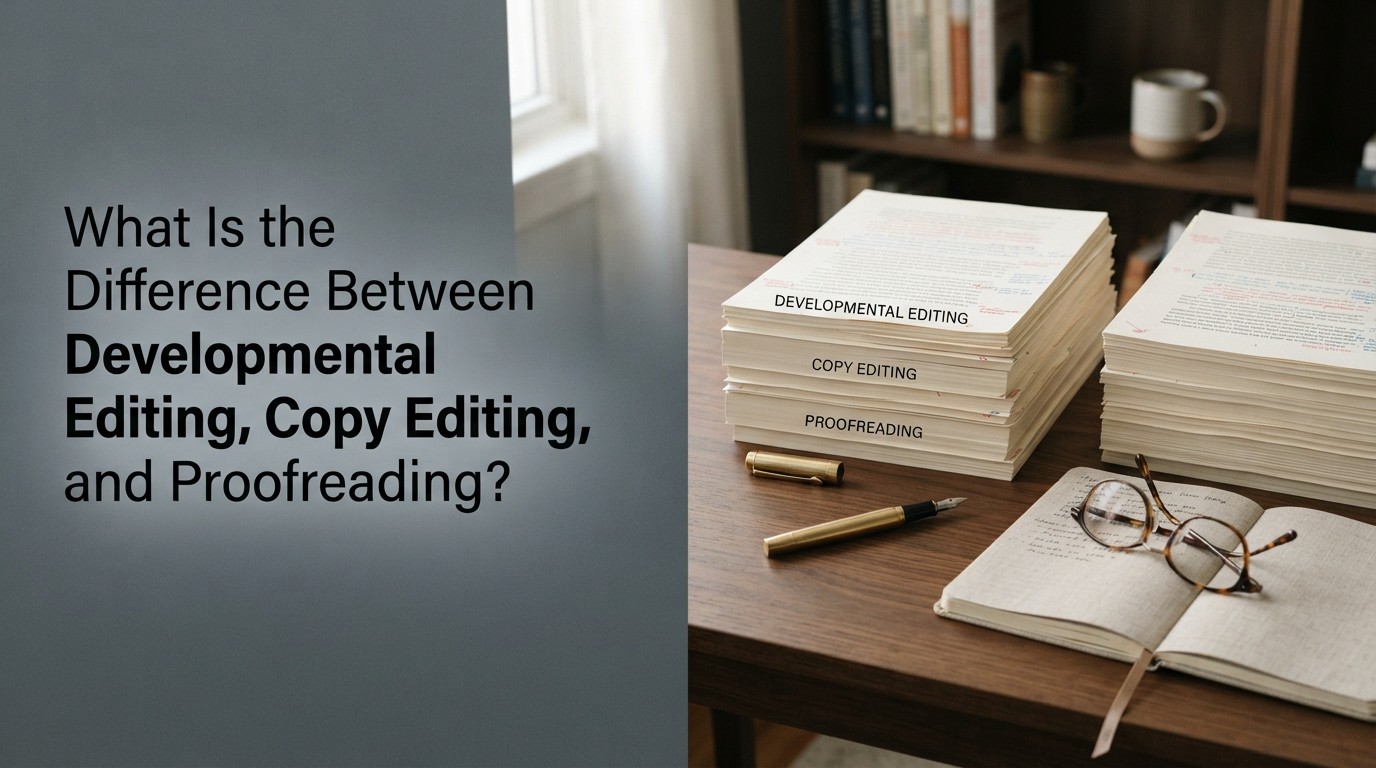
To achieve professional-grade quality, a manuscript must undergo a rigorous, multi-stage refinement process. However, many authors, content creators, and businesses struggle to understand the distinct phases of this process. A common misconception is that “editing” is a single, monolithic task. In reality, editing is a highly specialized pipeline consisting of distinct disciplines. To invest your resources wisely, you must understand the core question: What Is the Difference Between Developmental Editing, Copy Editing, and Proofreading?
This comprehensive, deep-dive guide will analyze each stage of the editorial process. We will examine their unique objectives, methodologies, and deliverables. By the end of this article, you will know exactly which editorial service your manuscript requires to transform it from a raw draft into a polished, market-ready masterpiece.
The Editorial Pipeline: An Overview
Before diving into each specific type of editing, it is essential to understand the editorial pipeline as a funnel. This funnel moves systematically from macro-level structural issues to micro-level mechanical details. Attempting to mix these stages—such as fixing commas while a book’s narrative structure is still unresolved—leads to wasted time, inflated costs, and a compromised final product.
The standard professional workflow follows this sequence:
- Phase 1: Developmental Editing (Macro-level: Structure, plot, pacing, characterization, and thematic development).
- Phase 2: Copy Editing (Meso-level: Grammar, style, syntax, consistency, voice, and factual accuracy).
- Phase 3: Proofreading (Micro-level: Typographical errors, punctuation, layout anomalies, and final quality control).
Skipping any of these steps compromises the integrity of the work. Let us explore each phase in extensive detail to understand why they are distinct yet interdependent.
Phase 1: Developmental Editing (The Architectural Stage)
What Is Developmental Editing?
Developmental editing, sometimes referred to as structural or conceptual editing, is the first and most intensive stage of the editorial process. It focuses on the foundational architecture of the manuscript. If we compare writing a book to building a house, developmental editing is the stage where you inspect the blueprint, the foundation, and the framing. It does not matter how beautiful the wallpaper is (the prose) if the foundation is cracked and the walls are crooked.
A developmental editor looks at the manuscript as a cohesive whole. They analyze how the narrative or arguments are structured, whether the pacing keeps the reader engaged, and if the overall concept is successfully executed.
Core Areas of Focus in Developmental Editing
- Plot and Narrative Arc (Fiction): Does the story have a clear beginning, middle, and end? Are there plot holes? Is the inciting incident compelling, and does the climax feel earned?
- Character Development (Fiction): Are the characters multi-dimensional? Do they have clear motivations, internal conflicts, and satisfying arcs? Is their dialogue distinct and believable?
- Pacing and Tension: Does the narrative drag in the middle? Are scenes ordered in a way that maximizes dramatic tension or logical flow?
- Structural Organization (Non-Fiction): Is the argument presented logically? Do the chapters transition smoothly from one concept to the next? Is the thesis supported by sufficient evidence?
- Point of View (POV) and Voice: Is the narrative perspective consistent? Does the manuscript suffer from “head-hopping” (unintentionally shifting between different characters’ thoughts in the same scene)?
What the Developmental Editor Delivers
Unlike copy editors, developmental editors rarely make direct, line-by-line corrections in the manuscript. Instead, their deliverables are highly analytical and strategic. They typically provide:
- An Editorial Letter (or Editorial Report): A comprehensive document (often 5 to 20 pages long) detailing the manuscript’s strengths, weaknesses, and specific recommendations for revision.
- Annotated Manuscript: Marginal comments throughout the text highlighting specific areas where pacing flags, character actions feel unearned, or structural adjustments are needed.
- Chapter-by-Chapter Outlines: Sometimes used to help the author visualize the flow of information or narrative beats.
When Do You Need Developmental Editing?
Developmental editing is essential when you have completed a rough first draft and feel that “something isn’t working,” but you cannot pinpoint what it is. It is also invaluable for authors who want to ensure their book meets genre expectations and resonates deeply with their target audience.
Phase 2: Copy Editing (The Mechanical and Stylistic Refinement)
What Is Copy Editing?
Once the structural foundation of the manuscript is secure, the text is ready for copy editing. Copy editing operates at the sentence and paragraph level. The primary goal of a copy editor is to ensure that the prose is clear, correct, consistent, and cohesive.
Many people confuse copy editing with proofreading, but copy editing is far more invasive. A copy editor does not just look for spelling mistakes; they analyze sentence structure, improve readability, refine the author’s voice, and enforce strict stylistic rules.
The Spectrum of Copy Editing
Copy editing is often categorized into three levels of intensity, depending on the needs of the manuscript:
- Light Copy Editing: Focuses primarily on correcting objective errors in grammar, spelling, punctuation, and syntax. It ensures basic consistency in capitalization, hyphenation, and number treatment.
- Medium Copy Editing: Includes everything in light editing, plus improvements to sentence structure, word choice, and transitions. The editor will flag repetitive phrasing, clunky syntax, and minor factual inconsistencies.
- Heavy Copy Editing (Line Editing): Often borders on rewriting. The editor focuses heavily on the artistic flow of the language (cadence, tone, and voice). They will tighten bloated prose, eliminate jargon, and restructure paragraphs to maximize impact while preserving the author’s unique voice.
Core Areas of Focus in Copy Editing
- Grammar and Syntax: Correcting dangling modifiers, run-on sentences, subject-verb agreement issues, and improper tense shifts.
- Consistency: Ensuring that a character’s eyes do not change from blue to green, or that a company’s name is spelled the same way throughout a corporate report.
- Style Guide Adherence: Applying the rules of specific style manuals, such as the Chicago Manual of Style (CMOS) for fiction and general non-fiction, the Associated Press (AP) Stylebook for journalism, or the American Psychological Association (APA) style for academic works.
- Fact-Checking: Verifying basic facts, such as historical dates, geographical locations, scientific terms, and public figures’ names.
What the Copy Editor Delivers
A copy editor works directly within the manuscript document (typically using Microsoft Word’s Track Changes or Google Docs’ Suggesting mode). Their deliverables include:
- The Marked-Up Manuscript: A document showing every single deletion, insertion, and transposition, along with queries in the margins regarding clarity or factual accuracy.
- A Style Sheet: A customized document created specifically for your manuscript. It lists the spelling of unusual names, fictional terms, capitalization choices, and specific style rules applied to ensure consistency across the entire project.
Phase 3: Proofreading (The Final Quality Gatekeeper)
What Is Proofreading?
Proofreading is the absolute final stage of the editorial cycle. It takes place after the manuscript has been copy-edited, revised, designed, and formatted into its final layout (known as the “proof” or “galley”).
The term “proofreading” originates from traditional printing, where the proofreader read the metal “proofs” of typeset pages to find errors before the plates went to the printing press. Today, the role remains the same: it is a cold-eye, meticulous check to catch any lingering errors that slipped through previous rounds of editing, as well as any formatting errors introduced during the layout and design process.
Crucial Rule: Proofreading is not the time to rewrite paragraphs, alter character arcs, or change stylistic preferences. Making significant changes at this stage is expensive, time-consuming, and risks introducing new, unnoticed errors.
Core Areas of Focus in Proofreading
- Typographical and Spelling Errors: Catching misspelled words, homophone slip-ups (e.g., their/there/they’re), and missing or double spaces.
- Punctuation Mistakes: Ensuring proper placement of commas, periods, quotation marks, and hyphens.
- Formatting and Layout Issues: Checking for “widows and orphans” (single lines of text left isolated at the top or bottom of a page), incorrect page numbering, inconsistent running headers, misaligned margins, and broken word breaks at the end of lines.
- Cross-References: Verifying that table of contents page numbers match the actual chapters, and that figure captions correspond to the correct images.
What the Proofreader Delivers
Proofreaders often work on designed PDF files using annotation tools, or directly on printed pages using traditional proofreader marks. They deliver a clean, marked-up proof showing exactly where mechanical corrections must be made before the file is sent to the printer or uploaded to a digital distribution platform.
Comparative Analysis: Side-by-Side Comparison
To help you visualize how these three services differ, the following comparison table outlines the key parameters of each editorial stage:
| Feature | Developmental Editing | Copy Editing | Proofreading |
| Structure, plot, pacing, organization, and thematic depth. | Grammar, style, syntax, clarity, and consistency. | Spelling, punctuation, typos, and formatting errors. | Primary Focus |
| First stage (immediately after the rough draft is complete). | Second stage (after structural revisions are finalized). | Final stage (after book design/formatting, before publication). | Stage in Process |
| Macro-level (chapters may be deleted, added, or rewritten). | Meso-level (sentences and paragraphs are refined and polished). | Micro-level (isolated character and formatting corrections). | Level of Change |
| Rarely applies style guides; focuses on storytelling or rhetoric. | Strictly adheres to style guides (e.g., CMOS, AP, APA). | Ensures consistent application of the chosen style guide. | Style Guide Use |
| Editorial letter and annotated structural manuscript. | Tracked changes manuscript and custom Style Sheet. | Marked-up page proofs (PDF or hard copy) with corrections. | Deliverables |
Why You Cannot Skip Stages: The Cost of a Broken Workflow
In an effort to save money, some authors or organizations attempt to bypass certain stages of the editorial pipeline. The most common shortcut is hiring a proofreader to look at a raw draft, expecting them to fix structural problems. This is a fundamental misunderstanding of the process that leads to poor outcomes.
Consider these scenarios of a broken workflow:
- Skipping Developmental Editing: You hire an excellent copy editor to refine your sentences. They deliver a beautifully written, grammatically flawless manuscript. However, when you publish it, readers complain that the plot makes no sense, the characters are boring, and the ending is completely unsatisfying. You have paid for beautiful prose on a broken narrative structure.
- Skipping Copy Editing: You go straight from a developmental revision to a proofreader. The proofreader catches typos and punctuation errors, but they cannot rewrite clunky sentences or fix awkward transitions because that is outside their scope of work. Your book is published without typos, but the writing feels amateurish, repetitive, and difficult to read.
- Skipping Proofreading: You finish copy editing and immediately publish the formatted file. Unfortunately, during the formatting process, several paragraphs were accidentally duplicated, a chapter header was deleted, and dozens of line breaks were broken. Readers leave negative reviews pointing out these glaring formatting glitches, damaging your professional credibility.
Investing in professional book editing is the single most effective way to protect your intellectual property, respect your readers’ time, and ensure your message is received exactly as you intended.
How to Assess What Your Manuscript Needs Right Now
If you are unsure which service to hire, ask yourself the following diagnostic questions about your current draft:
1. Is the core message, story, or argument complete and logical?
If you have doubts about whether your chapters are in the right order, if your fiction plot has holes, or if your non-fiction book lacks sufficient supporting evidence, you need Developmental Editing.
2. Are the structure and content locked in, but the language feels clunky?
If you are confident that every chapter belongs exactly where it is, but you struggle with repetitive vocabulary, passive voice, confusing sentence structures, or maintaining a consistent tone, you need Copy Editing.
3. Has the text been thoroughly edited, revised, and formatted into its final layout?
If your book has been through multiple rounds of revisions, has been styled by a book designer, and is ready for public distribution, you need Proofreading to catch any last-minute errors before the “publish” button is pressed.
Frequently Asked Questions
Can one editor do all three types of editing at once?
No. It is virtually impossible to perform developmental editing, copy editing, and proofreading simultaneously. Each stage requires a completely different mindset. A developmental editor focuses on big-picture concepts, while a proofreader must ignore the big picture and focus strictly on mechanical details. Furthermore, once an editor has read a manuscript multiple times during developmental and copy editing, they lose their “fresh eyes” and will naturally overlook minor typos. This is why different professionals should handle different stages of the process.
What is the difference between line editing and copy editing?
While often grouped together, line editing focuses on the creative, stylistic, and artistic aspects of the writing (voice, flow, readability, and emotional impact). Copy editing focuses on the technical, rule-based aspects of the text (grammar, spelling, punctuation, style guide compliance, and factual consistency). Many editors offer a combined service that addresses both stylistic and technical elements.
How much do these different editing services typically cost?
Pricing varies widely based on the editor’s experience, the genre, the length of the manuscript, and the depth of work required. Generally, developmental editing is the most expensive because it requires deep intellectual analysis and strategic planning. Copy editing is moderately priced, and proofreading is typically the most affordable because it is the least invasive and fastest stage of the process.
Should I self-edit before hiring a professional?
Absolutely. You should always self-edit your manuscript to the absolute best of your ability before handing it over to a professional. This ensures that your editor is not wasting time on basic errors you could have fixed yourself. Instead, they can focus their highly specialized skills on resolving complex issues that you might not have the training to spot.
How long does the entire editing process take?
For a standard 80,000-word manuscript, the entire editorial pipeline can take anywhere from three to six months. Developmental editing and subsequent author revisions take the longest (often several weeks or months). Copy editing typically takes two to four weeks, and proofreading can usually be completed in one to two weeks. Proper planning is essential to ensure you do not rush these critical quality-control steps.
Conclusion
In the world of professional publishing, there are no shortcuts to quality. Understanding the distinct roles of developmental editing, copy editing, and proofreading allows you to navigate the editorial pipeline with confidence and precision. By applying the right type of editing at the right stage of your manuscript’s development, you protect your financial investment, honor your creative vision, and deliver a polished, professional product that readers will value.
Whether you are an aspiring novelist, an academic researcher, or a business leader producing high-stakes content, partnering with professional editors is the key to elevating your writing from good to exceptional. Take the time to evaluate where your manuscript stands today, and choose the appropriate editorial specialist to guide your work toward its final, polished form.


