
Introduction
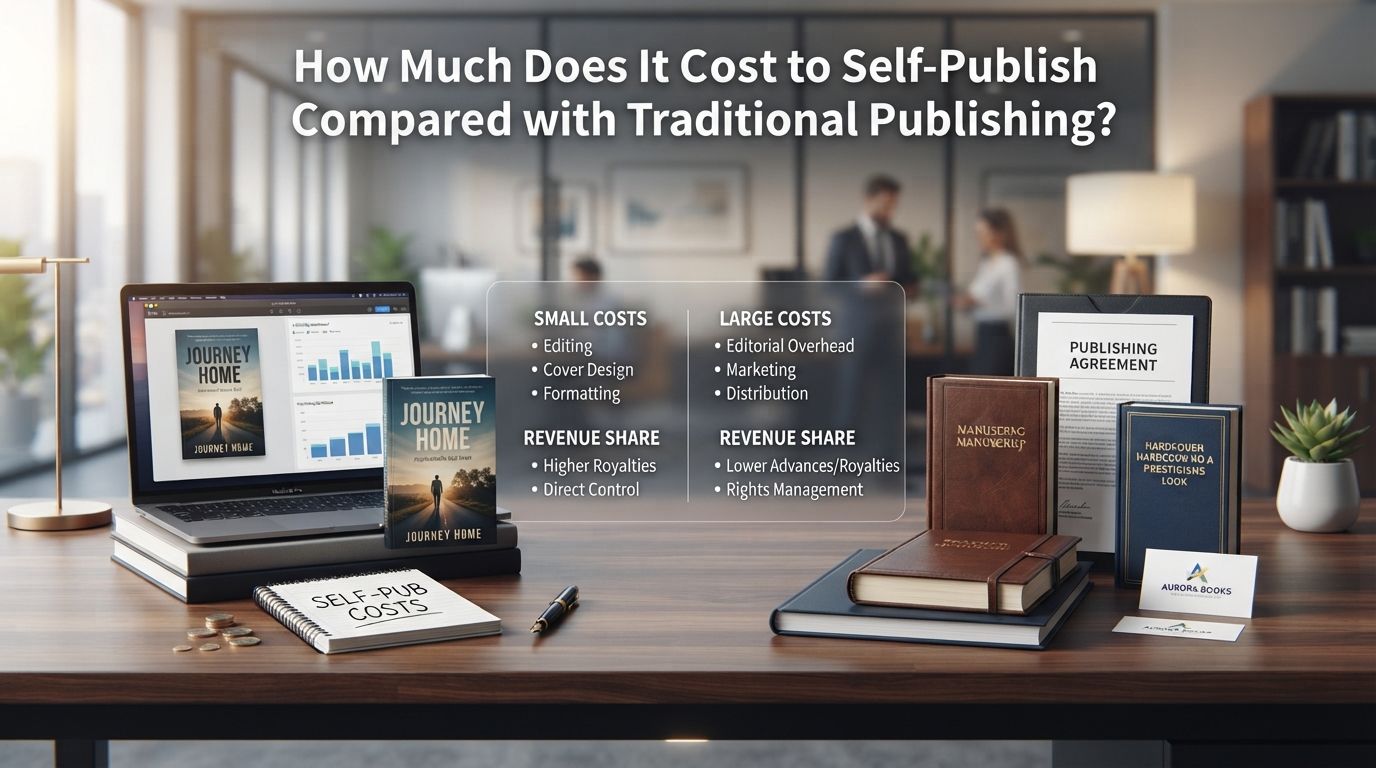
The global publishing landscape has undergone a massive paradigm shift over the last two decades. No longer are authors entirely dependent on the gatekeepers of New York or London’s major publishing houses to bring their stories, insights, and research to the world. Today, independent publishing (self-publishing) stands as a highly viable, lucrative, and respectable alternative to the traditional publishing model. However, as with any business venture, entering the literary market requires a clear understanding of the financial commitments involved. This brings us to one of the most critical questions aspiring authors must ask: How Much Does It Cost to Self-Publish Compared with Traditional Publishing?
To answer this question accurately, we must look beyond superficial estimates. Publishing a book is not merely about putting words on a page and uploading a file to Amazon; it is a multi-step process involving editorial refinement, cover design, interior layout, distribution setup, and ongoing marketing. While traditional publishing is often marketed as “free” to the author, it carries hidden costs, long timelines, and significant opportunity costs. Conversely, self-publishing requires upfront capital but offers unmatched royalty rates and complete creative control. This comprehensive guide breaks down every line item, comparing the true financial realities of both models so you can make an informed, strategic decision for your author career.
The Financial Philosophy: Investment vs. Equity
Before diving into individual cost categories, it is vital to understand the underlying financial philosophy of each publishing path. The fundamental difference lies in who carries the financial risk and who retains the equity of the intellectual property.
In traditional publishing, the publisher assumes the entire financial risk. They pay for editing, design, distribution, and sometimes a small portion of marketing. In exchange for absorbing this risk, they retain the rights to your book and pay you a relatively small percentage of the sales (royalties). Essentially, you are licensing your intellectual property to a corporate entity in exchange for a royalty and, in some cases, an upfront advance.
In self-publishing, you act as the publisher. You are a business owner. You assume 100% of the financial risk upfront, which means you must fund the editing, design, formatting, and marketing out of pocket. However, because you assume the risk, you also retain 100% of the rights and receive the lion’s share of the royalties—typically 70% on digital sales, compared to the 10% to 25% offered by traditional publishers.
How Much Does It Cost to Self-Publish? (The Detailed Breakdown)
When self-publishing, the total cost can vary wildly depending on your goals, your genre, and your willingness to execute certain tasks yourself. A hobbyist author might publish a book for under $500, while a professional author aiming for the bestseller lists may invest upwards of $5,000 to $10,000. Below is a detailed analysis of the essential expenses involved in professional self-publishing.
1. Editorial Services (The Critical Investment)
Editing is the single most important expense in self-publishing. Readers have zero tolerance for typos, plot holes, or poor pacing, and a poorly edited book will quickly earn negative reviews, killing its sales potential. Professional editing is typically broken down into three main phases:
- Developmental Editing: This high-level edit focuses on story structure, character arcs, pacing, and overall flow. For non-fiction, it assesses the clarity of your thesis and the logical flow of your arguments. Cost: $0.02 to $0.04 per word ($1,600 to $3,200 for an 80,000-word manuscript).
- Copyediting: This phase addresses sentence structure, grammar, punctuation, consistency, and style. Cost: $0.015 to $0.025 per word ($1,200 to $2,000 for an 80,000-word manuscript).
- Proofreading: The final pass before publishing to catch lingering typos, spelling errors, and formatting glitches. Cost: $0.01 to $0.015 per word ($800 to $1,200 for an 80,000-word manuscript).
While some authors combine copyediting and proofreading to save money, skipping professional editing entirely is a recipe for commercial failure.
2. Cover Design (Your Primary Sales Tool)
People absolutely judge books by their covers. Your cover is your primary marketing tool; it must instantly convey your book’s genre, tone, and quality. A cover that looks amateurish will deter buyers, no matter how brilliant the writing inside is.
- Pre-made Covers: Good for budget-conscious authors or those writing in highly formulaic genres (e.g., romance, thriller quick-releases). Cost: $50 to $200.
- Custom Digital Cover Design: A unique design tailored specifically to your book, utilizing stock photography and professional typography. Cost: $300 to $800.
- Illustrated/Premium Custom Design: Essential for fantasy, sci-fi, children’s books, or high-end non-fiction where custom artwork is required. Cost: $800 to $2,000+.
3. Formatting and Interior Design
Your book must be formatted correctly for both digital (ePub) and print (PDF) layouts. Poor formatting can lead to awkward page breaks, unreadable fonts on e-readers, and mismatched margins in print copies.
- Do-It-Yourself (DIY) Software: Tools like Vellum (Mac-only) or Atticus allow authors to format their own books beautifully. Cost: $200 to $250 (one-time software purchase).
- Professional Formatting Services: Hiring a professional interior designer to handle complex layouts, especially for non-fiction with charts, tables, or images. Cost: $150 to $500.
4. Book Preparation & Ghostwriting Services
For many busy entrepreneurs, executives, and thought leaders, the biggest hurdle to publishing is the actual writing phase. To overcome this, many turn to professional book-writing agencies. Working with an agency like Ghostwriting Saga ensures that your book is written to industry-standard quality, structured for maximum engagement, and prepared for immediate market entry. This service combines outline creation, drafting, and developmental editing into a single professional package, saving authors hundreds of hours of labor and ensuring a world-class final product.
5. ISBNs and Distribution Setup
An International Standard Book Number (ISBN) is a unique identifier for your book. While platforms like Amazon KDP offer free ISBNs, using them limits your distribution options. To sell your book in bookstores, libraries, and other online retailers, you should purchase your own ISBNs.
- In the US (Bowker): A single ISBN costs $125, but a pack of 10 costs $295, which is highly recommended for authors planning to publish print, ebook, and audiobook formats.
- In other countries: ISBNs are often free (e.g., in Canada through Library and Archives Canada) or heavily subsidized by the government.
6. Marketing and Launch Strategy
In self-publishing, if you do not market your book, no one will find it. A successful book launch requires an initial marketing budget to drive reviews, build momentum, and trigger retail algorithms.
- Review Campaigns (NetGalley, BookSprout): Cost: $50 to $399.
- Paid Newsletter Promotions (BookBub, Bargain Booksy): Cost: $100 to $800 per promotion.
- Advertising (Amazon Ads, Facebook Ads): Recommended testing budget: $150 to $500 per month during the launch phase.
The True Costs of Traditional Publishing (The Myth of “Free”)
The primary appeal of traditional publishing is that the publisher pays for the production. You do not pay for editing, cover design, formatting, or printing. In fact, they pay you an advance against royalties. However, claiming traditional publishing is entirely free is a misconception. There are significant direct and indirect costs that authors must navigate.
1. Literary Agent Commissions
To secure a contract with a “Big Five” publisher (Penguin Random House, HarperCollins, Simon & Schuster, Hachette, Macmillan), you almost always need a literary agent. While agents do not charge upfront fees, they take a standard commission on all your earnings.
- Standard Commission: 15% of your advance and 15% of all future royalties.
- Foreign/Subsidiary Rights: 20% commission on international or film/television adaptations.
2. Professional Proposal and Editing Support
Because the traditional market is incredibly competitive, many authors hire freelance developmental editors to polish their manuscripts *before* submitting them to agents. If your manuscript is not flawless, agents will simply pass. Non-fiction authors must also write an extensive, highly professional book proposal, which often requires hiring a professional proposal consultant. Cost: $500 to $3,000.
3. Self-Funded Marketing and Public Relations
Unless you are a celebrity, a politician, or an established bestselling author with a multi-million dollar contract, your traditional publisher will do very little marketing for your book. They will handle basic distribution and catalog listings, but the burden of active promotion falls squarely on the author’s shoulders. Many traditionally published authors find themselves spending thousands of dollars of their own money to hire private publicists, build websites, run social media campaigns, and travel for book tours. Cost: $1,500 to $5,000+.
4. The Opportunity Cost of Time
Time is money, and the traditional publishing timeline is notoriously slow. From the moment you sign a contract, it typically takes 12 to 24 months for your book to hit the shelves. In contrast, a self-published author can write, produce, and launch a book in 3 to 6 months. If you are using your book to generate leads for a business, establish authority, or launch a coaching program, waiting two years to get your book to market represents a massive loss of potential revenue.
Head-to-Head Comparison: Self-Publishing vs. Traditional Publishing Costs
To help you visualize the financial differences, let’s look at a side-by-side cost comparison for a standard 80,000-word non-fiction or fiction book designed to meet professional market standards.
| Expense Category | Self-Publishing (Professional Standard) | Traditional Publishing |
| $2,500 – $5,000 | $0 (Covered by publisher) | Developmental & Copyediting |
| $800 – $1,200 | $0 (Covered by publisher) | Proofreading |
| $300 – $1,500 | $0 (Covered by publisher) | Cover Design |
| $150 – $500 | $0 (Covered by publisher) | Interior Layout & Formatting |
| $125 – $295 | $0 (Covered by publisher) | ISBNs & Barcodes |
| $500 – $3,000+ | $1,000 – $5,000+ (Usually self-funded by author) | Marketing & PR (Launch Phase) |
| $0 (No agent needed) | 15% of all earnings | Agent Commissions |
| 3 – 6 Months | 12 – 24 Months | Production Timeline |
| 35% – 70% of list price | 8% – 15% of net/list price (Ebooks: 25%) | Royalty Rates |
| $4,375 – $11,495 | $1,000 – $5,000 (Mostly prep & marketing) | Average Upfront Author Cost |
Royalty Structures and the Math Behind ROI
When considering How Much Does It Cost to Self-Publish Compared with Traditional Publishing?, looking only at the upfront costs is a mistake. You must also calculate your potential Return on Investment (ROI) based on royalty payouts.
Let’s run a hypothetical scenario where an author sells 5,000 copies of an ebook priced at $4.99 and 2,000 copies of a paperback priced at $14.99.
Scenario A: The Self-Published Author
The self-published author receives a 70% royalty on the ebook and approximately 40% on the print book (after printing costs on platforms like KDP or IngramSpark).
- Ebook Sales Revenue: 5,000 copies x $4.99 x 70% = $17,465
- Paperback Sales Revenue: 2,000 copies x $14.99 x 40% = $11,992
- Total Gross Revenue: $29,457
- Minus Production Costs (Est. $5,000): $24,457 Net Profit
Scenario B: The Traditionally Published Author
The traditionally published author receives a 25% royalty on the net receipts of the ebook and a 10% royalty on the retail price of the paperback. We will assume the author received a modest $5,000 advance. Remember, the agent takes a 15% cut of all earnings.
- Ebook Sales Revenue: 5,000 copies x $4.99 x 25% = $6,237.50
- Paperback Sales Revenue: 2,000 copies x $14.99 x 10% = $2,998.00
- Total Royalty Earnings: $9,235.50
- Minus 15% Agent Fee: $1,385.32
- Net Royalty Earnings: $7,850.18
- Minus Self-Funded Marketing (Est. $2,000): $5,850.18 Net Profit
As this math demonstrates, even though the self-published author spent significantly more money upfront, their higher royalty rate allowed them to generate substantially more profit on the exact same number of book sales.
Key Takeaways
- Upfront Investment: Self-publishing requires an upfront financial investment of $2,000 to $10,000+ to achieve professional market standards, whereas traditional publishing requires little to no upfront manufacturing costs.
- Ownership & Control: Self-published authors retain 100% ownership of their intellectual property, while traditional authors must sign over their rights to the publishing house.
- Royalty Potential: Self-publishing offers vastly superior royalty rates (up to 70%), meaning you need to sell fewer copies to break even compared to traditional publishing (8% to 15%).
- Speed to Market: Self-publishing allows authors to launch within months, capitalizing on market trends and business opportunities immediately, whereas traditional publishing takes 1 to 2 years.
- Marketing Responsibility: Regardless of which path you choose, the vast majority of book marketing falls onto the author. Traditional publishers rarely provide robust marketing support for mid-list or debut authors.
Frequently Asked Questions
Is it possible to self-publish a book for free?
Technically, yes. You can write your book, design your own cover using free templates, format it yourself, and upload it to Amazon KDP for free. However, this is generally not recommended if you want to build a professional brand or sell copies. Books produced with zero budget usually suffer from poor editing and amateur covers, leading to poor reviews and virtually no sales.
Do traditional publishers pay for your book’s editing and cover design?
Yes. Reputable, traditional publishers will cover 100% of the editing, proofreading, formatting, cover design, and printing costs. They will also pay you an advance. You should never pay a traditional publisher to publish your book. If a publisher asks you for money, they are likely a hybrid publisher or a vanity press.
What is a vanity press, and how do they differ from self-publishing?
A vanity press is a company that charges authors thousands of dollars to publish their books under the guise of being a traditional publisher. They often provide low-quality services, retain your rights, and offer minimal royalties. True self-publishing involves hiring your own independent freelancers directly, keeping full control of your files, and retaining 100% of your royalties.
How many books do I need to sell to break even when self-publishing?
This depends on your initial production costs and retail price. If you spend $3,000 to produce your book and sell it as an ebook for $4.99 (earning roughly $3.50 per copy after Amazon’s fees), you will need to sell approximately 857 copies to break even. Any sales after that are pure profit.
Can I self-publish first and then get a traditional publishing deal later?
Yes. Many traditional publishers use the self-publishing market as a testing ground. If your self-published book sells thousands of copies and builds a highly engaged audience, traditional publishers may approach you to buy the print or foreign rights to your book. Famous examples include Colleen Hoover, Andy Weir (The Martian), and E.L. James (Fifty Shades of Grey).
Conclusion
When analyzing How Much Does It Cost to Self-Publish Compared with Traditional Publishing?, it becomes clear that there is no single “best” path. The right choice depends entirely on your personal goals, financial resources, timeline, and professional needs.
If your goal is prestige, physical placement in bookstore chains, and validation from the literary establishment, and you do not mind waiting 18 months to see your book in print, traditional publishing may be your ideal route. Just be prepared to invest your own time and money into marketing to ensure your book does not get lost in the shuffle.
On the other hand, if you are an entrepreneur, coach, business leader, or career author who wants to maximize profit margins, maintain absolute creative control, and get your message to the market immediately, self-publishing is an unparalleled vehicle. By investing in professional editing, stunning cover design, and a dedicated launch strategy, you can build a highly profitable literary asset that will generate royalties and leads for your business for decades to come.


